

Master the language of saying no to your manager with this C1 reading and speaking English lesson plan on burnout at work, built around the story of Jonas, a 24-year-old analyst who never said no, six warning signs of burnout, and a five-move language bank for turning a request into a trade-off with I’m at capacity and I can take that on if we deprioritise X.
Main objectives of this material
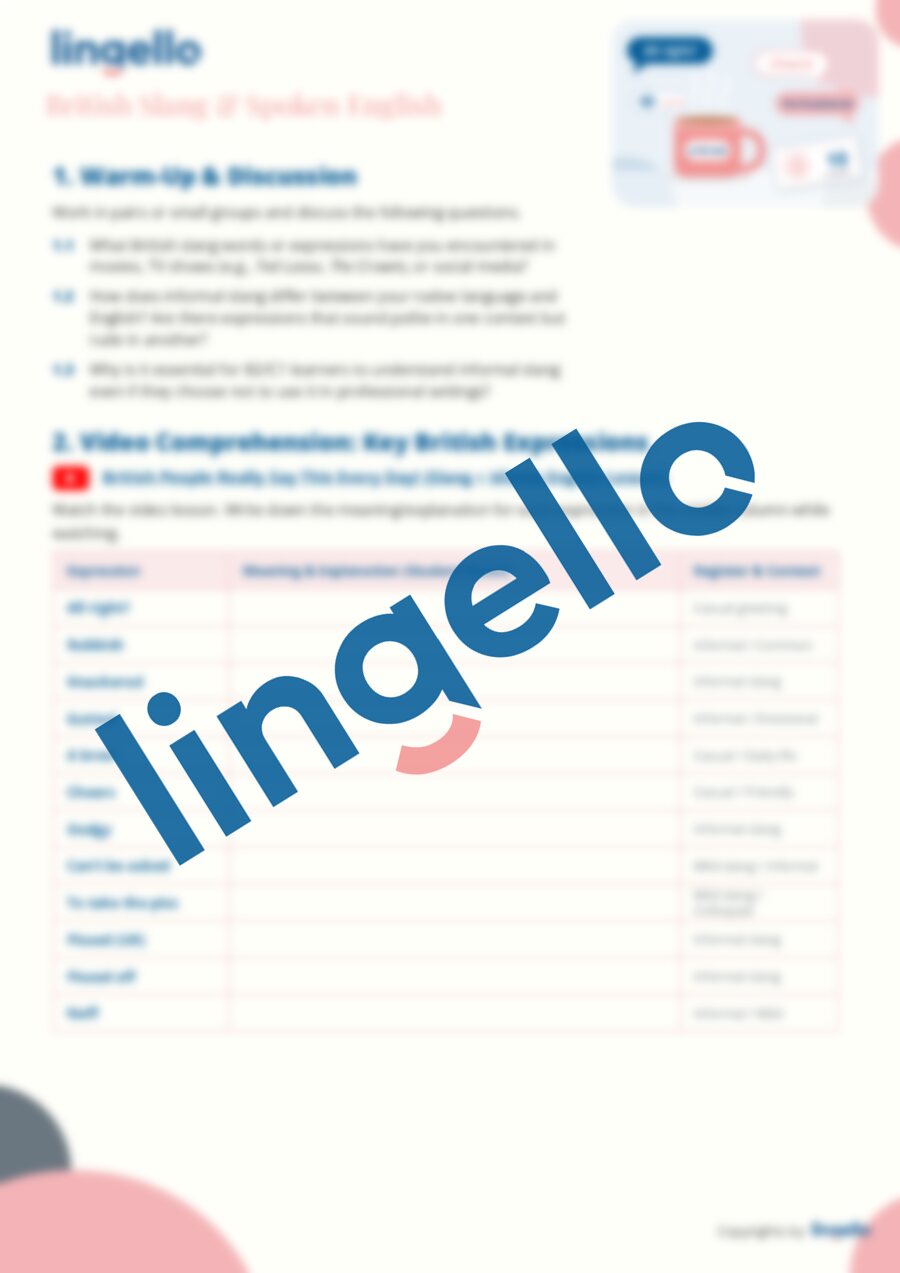
- Develop informal vocabulary related to everyday British English, including expressions such as All right?, cheers, dodgy, skint, a faff, cracking, bits and bobs and I’m not being funny but..., through a 24-item video note-taking table, three dialogue gap-fills and 24 flashcards.
- Strengthen listening and speaking skills by analysing the video British People Really Say This Every Day!, comparing British and American English in a nine-item table (from pissed meaning drunk in the UK and angry in the US to quid, fiver and tenner versus buck) and discussing how global media is blending UK and US slang.
- Learn and practise the connected speech reductions wanna and gonna, including their pronunciation, the rules for want to + verb and be + going to, and the cases where wanna cannot be used (want a + noun, want me to, wants to), to sound natural in informal conversation.
What students are going to cover
In this lesson, students will explore why B2-C1 learners need to understand informal British slang even if they choose not to use it at work, starting with three warm-up questions about slang in films, TV shows and social media. They watch a video lesson and note the meaning of 24 expressions, from All right? and knackered to numpty and ta, together with the register of each one. Students then complete three dialogues (at school, shopping with a mate and a dodgy night out) with 15 slang gaps, compare nine UK vs US vocabulary pairs and discuss three questions on misunderstandings and media influence. The grammar stage covers wanna and gonna with a ten-item exercise in which learners also decide when a reduction is incorrect, followed by three Speak Up! questions. The homework includes a ten-line dialogue with at least five slang expressions and a media analysis task, and the package adds a glossary, slides, flashcards and speaking cards. By the end of the lesson, learners will be able to explain 24 British slang expressions, avoid common UK/US misunderstandings, and use wanna and gonna correctly in informal speech.
🔒 Part of Complete · B2 · C1
Unlock this lesson with Complete
You are one step away from the full worksheet. Complete opens every lesson in the library, with new ones added every Sunday.
- Student Version PDF, print-ready, and an interactive fillable version
- Teacher Version with full answer key and teacher notes
- Presentation slides, glossary and a homework task
- Full access to every level, A1 to C2
Get Complete Start free with 10 lessons
Cancel anytime. Already a member? Log in to open this lesson.