

Explore whether people can truly change while developing advanced vocabulary, critical thinking, and IELTS exam skills.
Main objectives of this material
- Develop advanced workplace vocabulary for workload and boundaries, including expressions such as take something on, be at capacity, be stretched thin, have a lot on your plate, deprioritise, push back on, something has to give, run on empty, set boundaries and a trade-off, practised in a text, a strategy-matching task, a first-letter homework gap-fill, a fifteen-entry glossary and the flashcard set.
- Strengthen reading and critical discussion skills by analysing a 320-word profile of Jonas, who is eight months into his first job, runs three side projects on top of his own work and has been working late every night since January; students answer eight true-or-false statements, discuss four questions on the cost of saying yes, and match six warning signs of burnout (from you can’t switch off to “it’s temporary”) to six practical strategies.
- Learn and practise the present perfect continuous for describing a state that is still going on (I’ve been working late every night since January, How long have you been feeling like this?) against the present perfect simple, and the five moves of a good no - signal, show, offer, ask, close - using I’m stretched pretty thin this week, If this is the priority, something has to give, Which of these matters most to you? and I’d rather push back now than let you down on Friday.
What students are going to cover
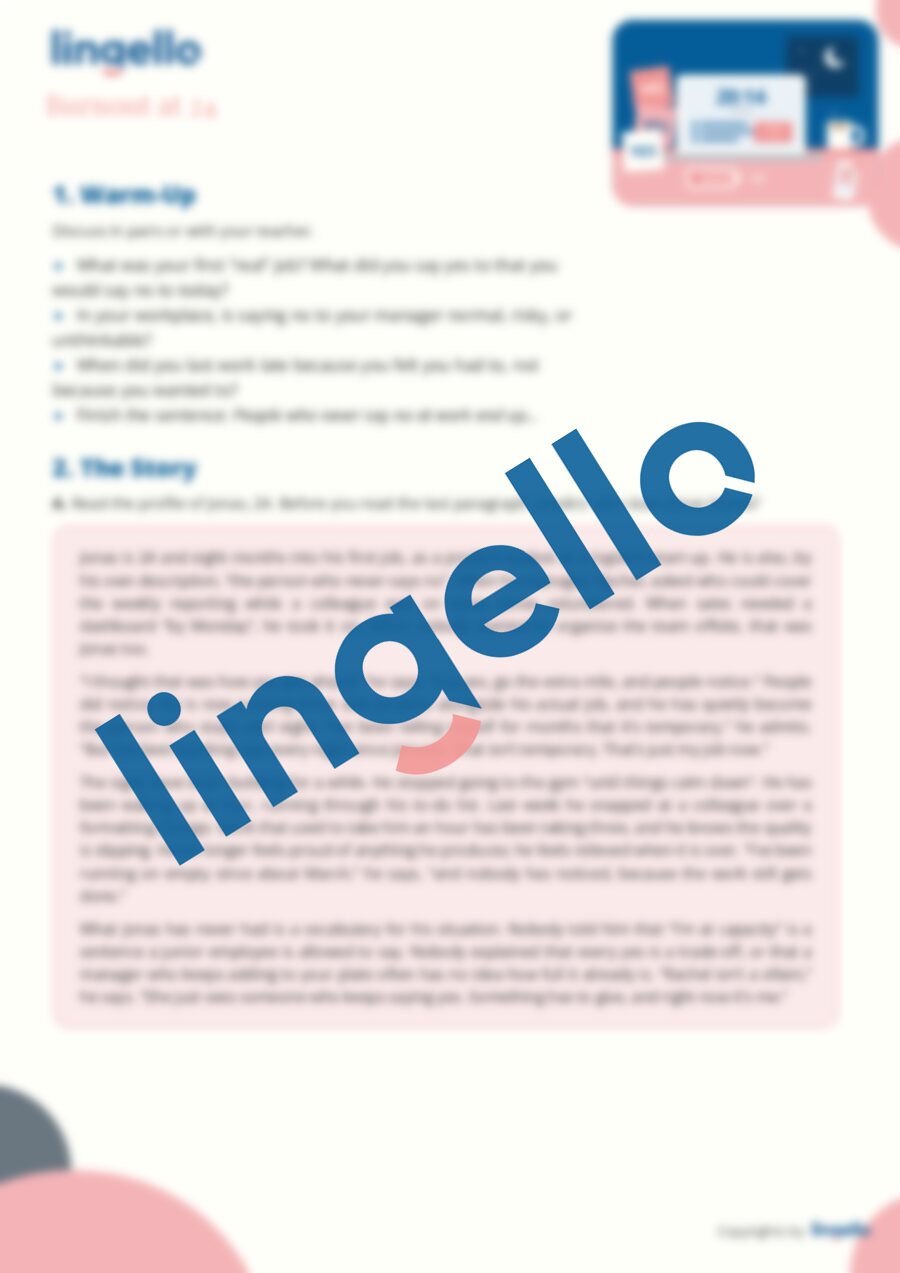
In this lesson, students will learn how to recognise burnout early and say no to a manager in English without apologising. They read the profile of Jonas, 24, predict who he blames, and check eight true-or-false statements about his first job. A box with six warning signs of burnout leads into a discussion on the cost of every yes and a task matching each sign to a practical strategy. A guided present perfect continuous section asks students to find five examples in the text, choose between continuous and simple in eight sentences, and describe their own situation (Lately I’ve been...). The core is a five-move language bank for saying no: students rewrite six blunt or over-apologetic lines, label the moves in Jonas’s message to his manager, then play three escalating scenario cards - a Friday favour, an extra project and a manager who says “we’re all busy” - against secret manager cards. Homework is an eleven-gap message from memory plus a 150-180-word email or a 90-second voice note. The package includes a teacher version, a fillable PDF, 22 slides, graphics, flashcards and speaking cards. By the end of the lesson, learners will be able to describe how long a situation has been going on, name their capacity in one sentence, and turn a new request into a trade-off and a clear question.
🔒 Part of Complete · C1
Unlock this lesson with Complete
You are one step away from the full worksheet. Complete opens every lesson in the library, with new ones added every Sunday.
- Student Version PDF, print-ready, and an interactive fillable version
- Teacher Version with full answer key and teacher notes
- Presentation slides, glossary and a homework task
- Full access to every level, A1 to C2
Get Complete Start free with 10 lessons
Cancel anytime. Already a member? Log in to open this lesson.