
Explore how the British upper class was once said to reveal itself through accent, posture, and the way a person walks, while building advanced vocabulary and emphatic grammar for sophisticated spoken English.
Main objectives of this material
- Develop advanced clinical vocabulary related to microbiology, neurology and emergency medicine, including terms such as germinate, deoxygenated dead tissue, offending bacterium, interneuron, block neurotransmitters, neutralize toxin, lockjaw and succumb to an illness, practised in a ten-item terminology matching task, a ten-gap contextual fill-in and a 25-card flashcard set.
- Strengthen listening and critical analysis skills by analysing the TED-Ed video on tetanus pathophysiology in five timestamped sections, answering fifteen comprehension questions on transmission, retrograde toxin transport, the three-step treatment protocol and the 20,000 annual neonatal deaths, and debating four agree-or-disagree statements on medical ethics and resource allocation.
- Learn and practise advanced conditionals for clinical reasoning using zero, first, second, third and both mixed conditionals, including inverted forms such as Had the surgical team debrided the wound earlier..., to express universal medical laws, triage decisions, retrospective case reviews and counterfactual public health scenarios.
What students are going to cover
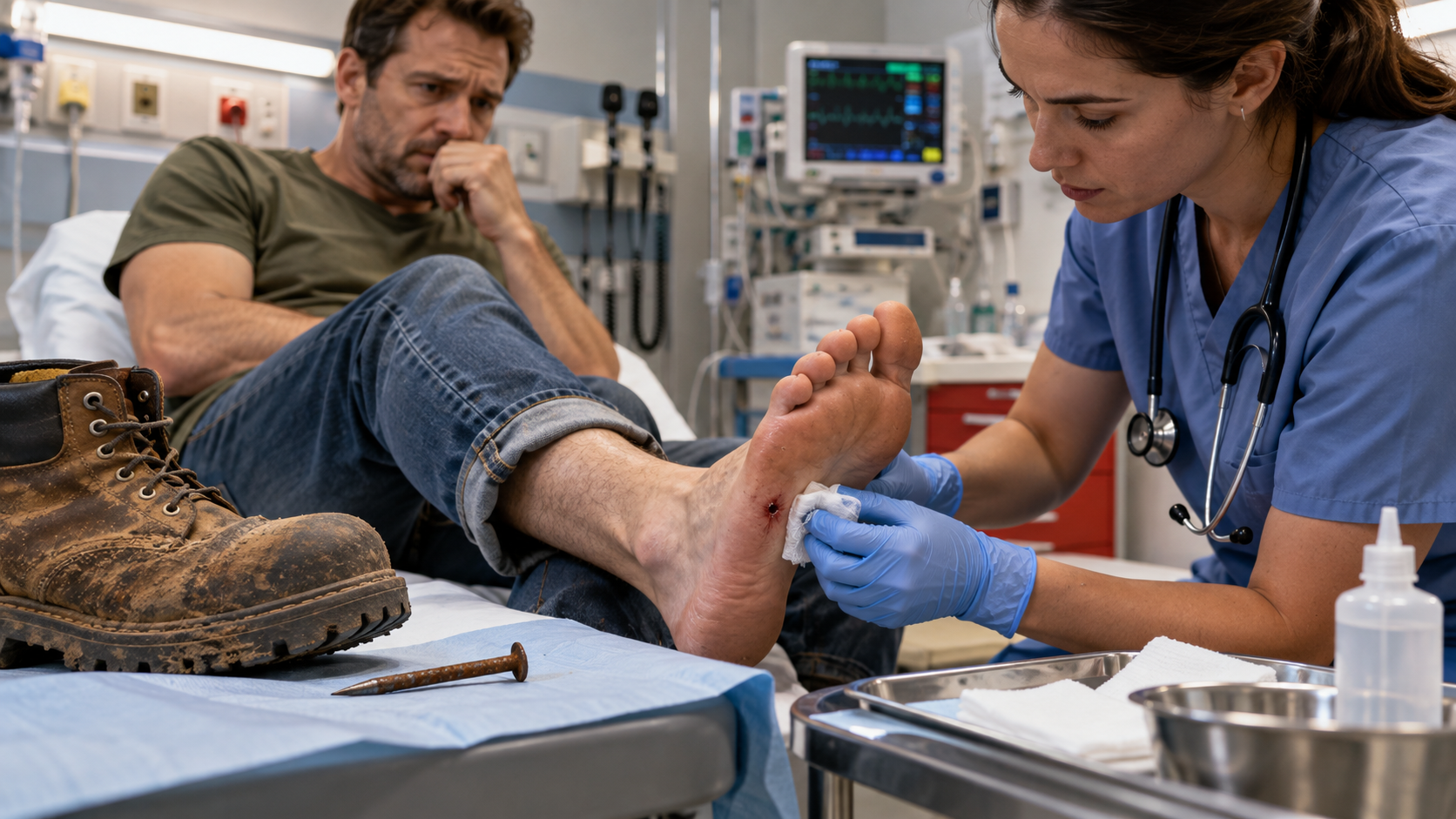
In this lesson, students will explore why a rusty nail is dangerous and how modern medicine manages tetanus, working through the TED-Ed video Why is it so dangerous to step on a rusty nail? by Louise Thwaites. After three warm-up questions on medical myths, they justify their position on four ethics statements about mandatory maternal vaccination, prevention spending, simplified health messaging and ICU allocation. They build advanced clinical lexis through a ten-item terminology matching task and a ten-gap clinical summary, then analyse the video in five timestamped sections with fifteen comprehension questions. The grammar focus presents six conditional types with medical examples, a ten-sentence verb conjugation exercise and ten clinical scenarios to rewrite as conditionals, before students plan a seven-minute pathogen profile presentation. Homework includes a 150-word case vignette, a 200-word analysis of eradication versus control and a podcast with six debate questions and a C1/C2 debate phrasebook; the package adds a 25-card flashcard set and a slide deck. By the end of the lesson, learners will be able to describe the pathophysiology of tetanus in precise clinical English, construct accurate mixed and inverted conditionals in triage and case-review contexts, and argue a public health position using diplomatic C2 discourse markers.
🔒 Part of Complete · C2
Unlock this lesson with Complete
You are one step away from the full worksheet. Complete opens every lesson in the library, with new ones added every Sunday.
- Student Version PDF, print-ready, and an interactive fillable version
- Teacher Version with full answer key and teacher notes
- Presentation slides, glossary and a homework task
- Full access to every level, A1 to C2
Get Complete Start free with 10 lessons
Cancel anytime. Already a member? Log in to open this lesson.