

Learn the English you need at the doctor’s office, from describing symptoms to understanding a doctor’s instructions in a real consultation.
Main objectives of this material
- Develop everyday vocabulary for weekend activities, including 12 very common irregular past forms such as went, had, saw, ate, met, bought and took, together with time expressions like last night, two days ago and on Saturday.
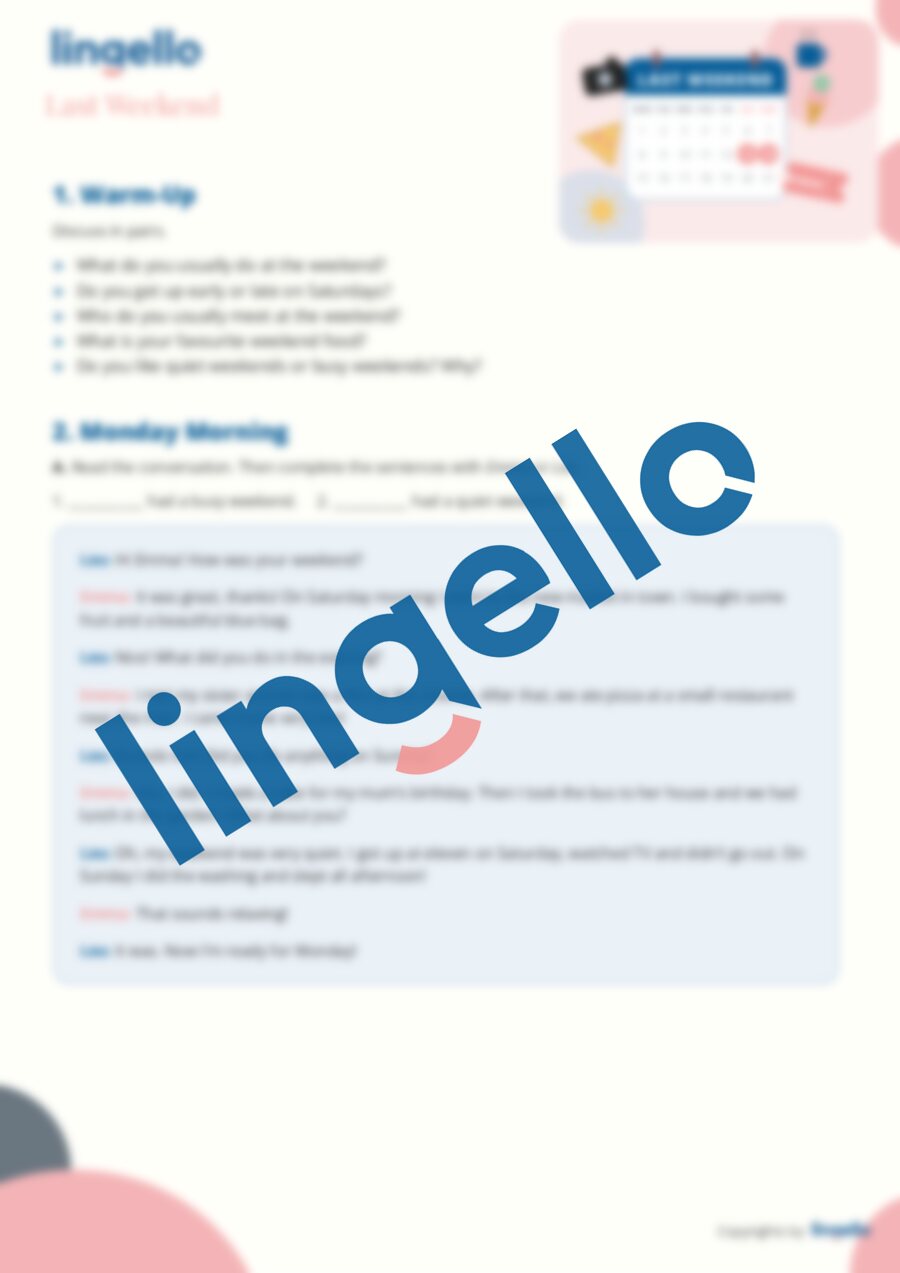
- Improve speaking and reading skills by analysing a Monday-morning conversation between two colleagues, telling the story of a character's weekend from nine pictures, and discussing how students spent their own weekends.
- Learn and practise the past simple in positive, negative and question forms using structures such as What did you do?, I didn't go out and Yes, I did to ask and answer about past events with confidence.
What students are going to cover
In this lesson, students will explore one of the most common small-talk questions in English, How was your weekend?, through a short conversation between two colleagues and a nine-picture story. They will build 12 high-frequency irregular past simple verbs and learn when to use on, in, at, last, yesterday and ago. Students strengthen reading and speaking skills through true-or-false tasks, a gap-fill message, picture-story retelling and a "find someone who" class survey. They also practise past simple questions and negatives with did and didn't. By the end of the lesson, learners will be able to tell a simple story about a past weekend, ask follow-up questions about other people's weekends, and answer with accurate past forms and time expressions.
🔒 Part of Complete · A2
Unlock this lesson with Complete
You are one step away from the full worksheet. Complete opens every lesson in the library, with new ones added every Sunday.
- Student Version PDF, print-ready, and an interactive fillable version
- Teacher Version with full answer key and teacher notes
- Presentation slides, glossary and a homework task
- Full access to every level, A1 to C2
Get Complete Start free with 10 lessons
Cancel anytime. Already a member? Log in to open this lesson.